
Brownstone Waterproofing in Brooklyn: What Every Homeowner Needs to Know
Brownstone Waterproofing in Brooklyn: What Every Homeowner Needs to Know
Shihab Jewel
Of everything that can damage a Brooklyn brownstone settling, pollution, aging mortar, traffic vibration water is the one that never stops. It falls from the sky, runs down your facade, seeps through hairline cracks, wicks up from the ground, and sits in your stoop joints through every freeze-thaw cycle winter delivers. A properly waterproofed brownstone can resist this for a decade. An unprotected one starts deteriorating from the moment the last coat wears off. Understanding waterproofing isn't just technical knowledge for brownstone owners, it's one of the most important things you can know about your home.
Unlike granite or marble, brownstone has an open pore structure that readily absorbs water on contact. Studies of historic New York masonry show brownstone can absorb water at rates several times higher than denser stones. When that absorbed water freezes which happens dozens of times each New York winter it expands by roughly 9% in volume inside the pores. That microscopic expansion, repeated hundreds of times over years, is what causes spalling, cracking, and surface delamination. This process, called freeze thaw cycling, is the primary mechanism of brownstone deterioration in Brooklyn's climate.
The porosity that makes brownstone vulnerable is also why waterproofing it requires a very specific approach. You can't simply coat the surface with a film forming sealer and call it done. Brownstone needs to breathe to allow trapped interior moisture to escape as vapor or you create a far worse problem: moisture gets locked in, accelerates rot, and causes the sealer itself to peel and pop.
"The single most damaging mistake we see on Brooklyn brownstones is the wrong sealer applied with good intentions — a film-forming coating that traps moisture inside the stone and accelerates the very deterioration it was meant to prevent."
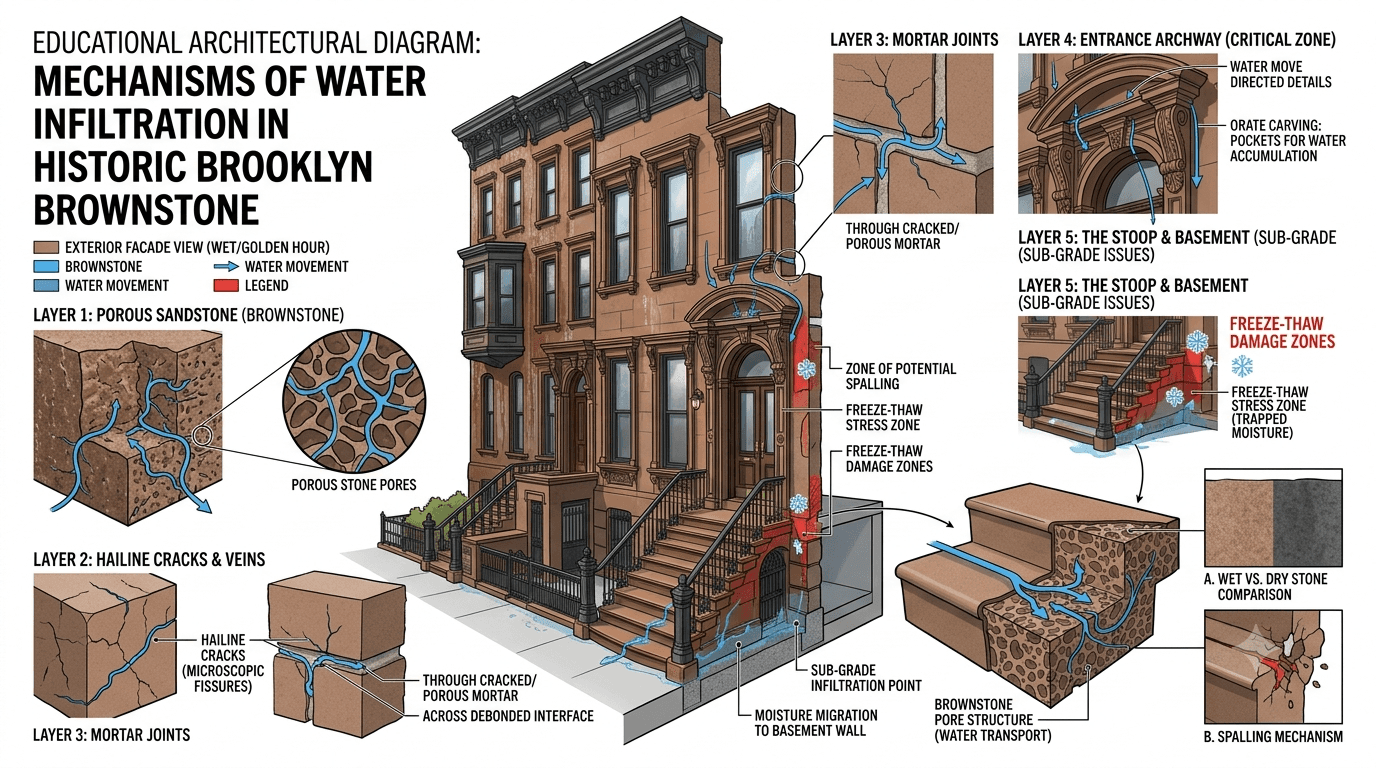
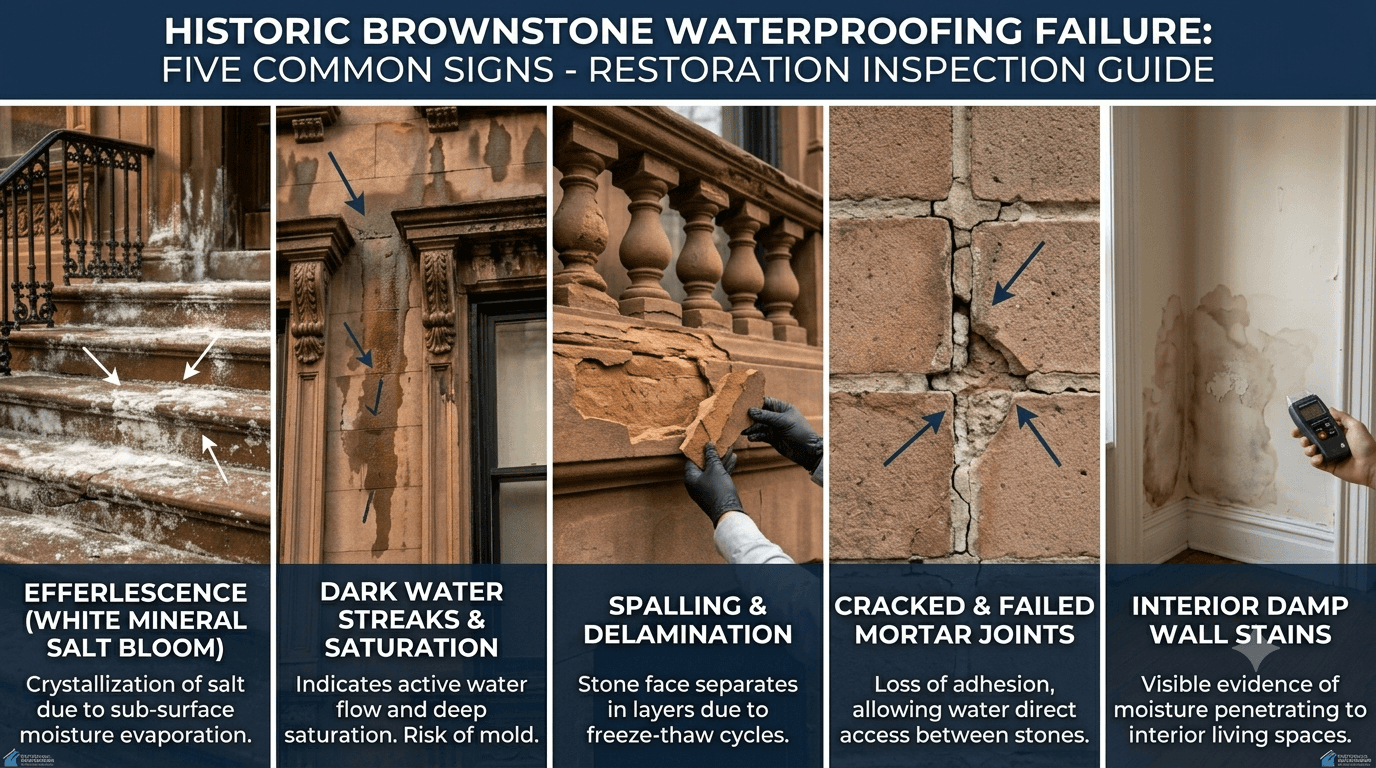
Signs your brownstone is losing its waterproofing protection
Waterproofing sealers don't fail all at once. They degrade gradually, and there are clear visual signals that protection is compromised before serious damage sets in. Here's what to look for:
A properly waterproofed facade sheds water in visible droplets after rain. If the stone absorbs water and simply darkens instead of beading, the sealer has worn through and reapplication is overdue. | ||
White crystalline staining on your facade is mineral salt deposited by water moving through the masonry. It's a direct indicator that water is infiltrating and traveling through your stone. | ||
Persistent dark streaks running down from cornices, window sills, or lintels mean water is channeling across your facade repeatedly — usually from failed flashing, clogged drainage, or unsealed penetrations. | ||
Surface delamination means freeze-thaw cycling has already begun destroying the stone's outer layer. At this stage, waterproofing alone isn't enough — you'll need facade repair work before a new sealer can be applied effectively. | ||
By the time water appears inside, it has already traveled through several inches of masonry. Interior moisture from facade infiltration always means more extensive damage than it first appears. |
"Noticing any of these signs? Read our detailed guide: 7 Warning Signs Your Brooklyn Brownstone Facade Needs Immediate Attention — including what each sign means and how urgent the repair timeline is."
The three types of waterproofing sealers — and which is right for brownstone
Walk into any home improvement store and you'll find a wall of waterproofing products. The differences between them are significant, and choosing the wrong one for brownstone isn't just ineffective — it can cause serious long-term damage. Here's how the main categories compare:
Penetrating Silane-Siloxane | Film-Forming Acrylic / Epoxy | Elastomeric Coating |
|---|---|---|
Soaks into pores and chemically bonds to stone from the inside, creating a water-repellent barrier without forming a surface film
Fully breathable moisture vapor escapes freely
Completely invisible — no change to stone color or texture
7–10 years with professional application ✓ Recommended for brownstone |
Dries as a visible film on the stone surface, creating a physical barrier against water
Non-breathable — traps interior moisture behind the film
Can add sheen or alter the stone's natural color
3–5 years before peeling begins ✗ Avoid on brownstone facades |
Thick, flexible rubber-like membrane applied over masonry; bridges small cracks as the wall moves
Some products offer limited vapor transmission, but most trap moisture
Visible coating — changes surface texture significantly
5–10 years; requires full removal before reapplication ~ Specialty use only; LPC restrictions apply |
For virtually all Brooklyn brownstone facades, a high-quality penetrating silane-siloxane sealer is the right choice. It bonds chemically with the stone's silicate minerals, repels water without altering the appearance or trapping vapor, and has a proven track record on historic masonry. Products like PROSOCO Siloxane PD and similar professional-grade formulations offer up to a 10-year service life when properly applied to a clean, sound surface.
What proper brownstone waterproofing actually involves
Professional waterproofing isn't just spraying a product on a facade. Done correctly, it follows a specific sequence — and skipping any step undermines the entire project.
| Full facade assessmentBefore any product is applied, a qualified contractor inspects the facade for active damage — cracked mortar joints, spalling stone, failed lintels, cracks, or previous coatings. Applying sealer over damaged masonry locks in the problem rather than solving it. | |||
| Repair work firstAny identified damage must be repaired before waterproofing begins. This typically means repointing failed mortar joints, patching spalled areas, sealing cracks with compatible materials, and addressing any drainage or flashing issues that are channeling water onto the facade. | |||
| Thorough cleaningThe facade must be completely clean and free of dirt, biological growth (algae, lichen), efflorescence, and any previous coatings before sealer is applied. Low-pressure washing with appropriate masonry cleaners is standard. High-pressure washing on brownstone can erode the surface a common mistake by inexperienced contractors. | |||
| Drying periodThe facade must be fully dry before sealer application typically 48–72 hours after cleaning, depending on weather conditions. Applying sealer to damp masonry prevents proper penetration and bonding, significantly reducing protection and longevity. | |||
| Sealer applicationProfessional application uses low-pressure spray equipment to saturate the facade uniformly, ensuring the sealer penetrates deep into the stone's pore structure rather than pooling on the surface. Two coats are typically applied wet-on-wet for maximum penetration and coverage. | |||
| Cure time and quality checkSilane-siloxane sealers begin to repel water within 24 hours and reach full cure in 3–7 days. A water bead test across the entire facade confirms uniform coverage and performance. Any missed areas or inadequate penetration are addressed before the project is closed out. | |||
The best and the worst times of year to waterproof your brownstone
Timing matters more than most homeowners realize. Silane-siloxane sealers require specific temperature and humidity conditions to penetrate properly and cure correctly. Here's a season-by-season guide for Brooklyn:
SpringIdeal
| SummerGood Warm and generally dry. Avoid application during peak heat above 90°F — sealer evaporates too quickly before penetrating. Schedule for early morning or overcast days. | FallIdeal The best time to protect your home before winter. Apply before first frost for full cure. Completing waterproofing by October gives your facade maximum protection heading into freeze-thaw season. | WinterAvoid Temperatures below 40°F prevent proper curing. Frozen or frost-covered masonry blocks sealer penetration entirely. Winter application is wasted material and effort. |
|---|
Common waterproofing myths debunked
Myth | Fact |
|---|---|
"If my brownstone looks fine, it doesn't need waterproofing." | Sealer wears out on a schedule, not when visible damage appears. By the time you see deterioration, protection has been gone for years. Proactive reapplication every 7–10 years prevents damage from ever starting. |
"Any waterproofing sealer from the hardware store will work fine." | Consumer sealers often contain film-forming agents that trap moisture in brownstone — accelerating the damage they're meant to prevent. Professional-grade penetrating sealers use different chemistry and concentration levels. |
"Painting the facade is a good way to waterproof it." | Paint traps moisture inside the stone and is one of the most destructive treatments applied to brownstones. Many NYC restoration projects involve costly paint removal before proper repairs can begin. Never paint a brownstone facade. |
"I can skip waterproofing if my mortar joints were just repointed." | Repointing and waterproofing address different vulnerabilities. Fresh mortar still allows water to wick through the stone itself. The two treatments work best together — repoint first, then seal the entire surface. |
LPC considerations for waterproofing in Brooklyn's historic districts
If your brownstone sits within a designated historic district which includes much of Park Slope, Brooklyn Heights, Fort Greene, Clinton Hill, Cobble Hill, Carroll Gardens, and Boerum Hill waterproofing treatments visible from the street require review under NYC Landmarks Preservation Commission (LPC) guidelines.
The good news is that properly specified penetrating silane-siloxane sealers are generally LPC-compliant, as they don't alter the appearance of the stone surface. What the LPC does scrutinize is the use of coatings that change the facade's color, texture, or reflectivity exactly the type of product you should be avoiding anyway.
A qualified brownstone restoration contractor will know which products are pre-approved for use in your district and will handle any required LPC filings. Working without proper LPC compliance in a landmarked area creates costly problems when you sell or attempt further work on the property, so it's always worth doing this correctly from the start.
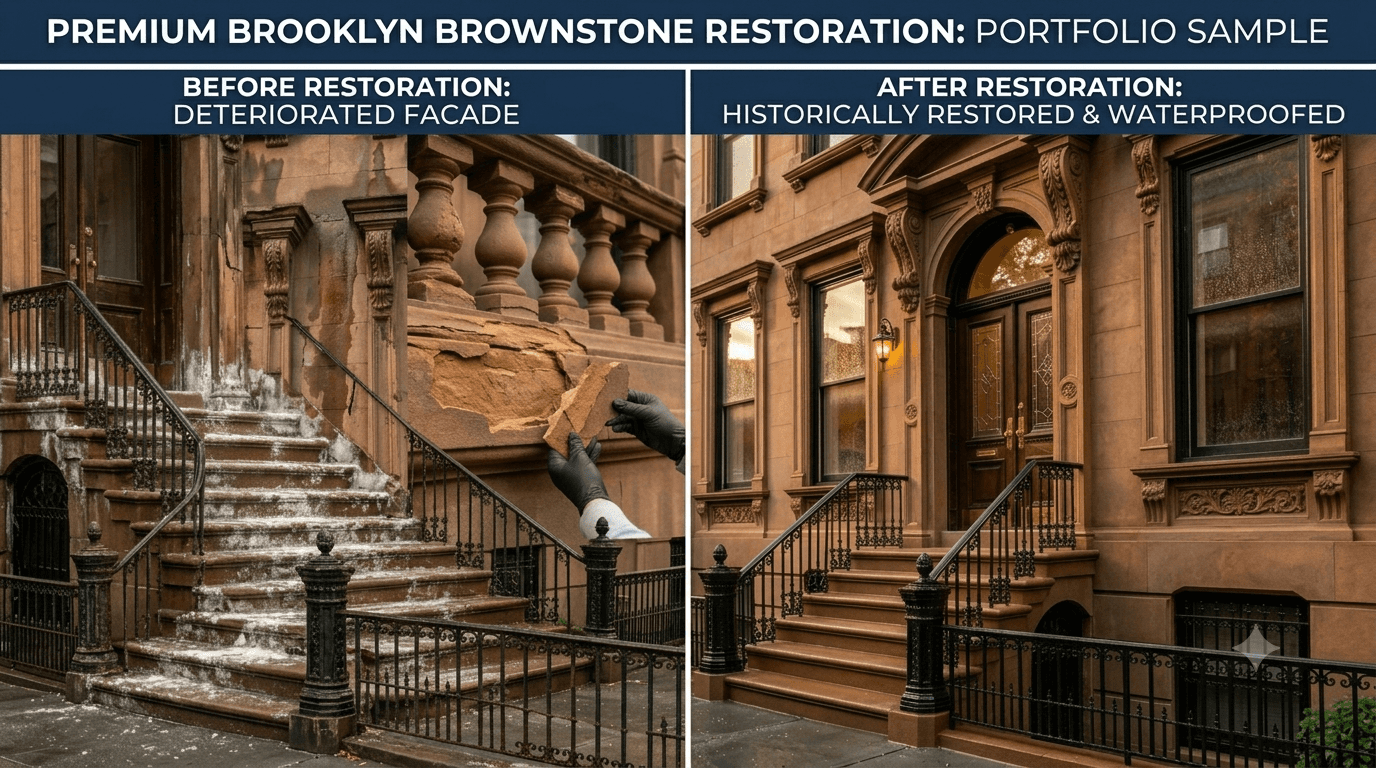
Don't let hidden moisture compromise the structural integrity and timeless beauty of your historic home. Whether you are noticing early signs of efflorescence, dark water streaks, or advanced spalling, catching deterioration early is key to preserving your property's value. The below picture shows how professional waterproofing and stone repair can completely revitalize a weathered facade.
Of everything that can damage a Brooklyn brownstone settling, pollution, aging mortar, traffic vibration water is the one that never stops. It falls from the sky, runs down your facade, seeps through hairline cracks, wicks up from the ground, and sits in your stoop joints through every freeze-thaw cycle winter delivers. A properly waterproofed brownstone can resist this for a decade. An unprotected one starts deteriorating from the moment the last coat wears off. Understanding waterproofing isn't just technical knowledge for brownstone owners, it's one of the most important things you can know about your home.
Unlike granite or marble, brownstone has an open pore structure that readily absorbs water on contact. Studies of historic New York masonry show brownstone can absorb water at rates several times higher than denser stones. When that absorbed water freezes which happens dozens of times each New York winter it expands by roughly 9% in volume inside the pores. That microscopic expansion, repeated hundreds of times over years, is what causes spalling, cracking, and surface delamination. This process, called freeze thaw cycling, is the primary mechanism of brownstone deterioration in Brooklyn's climate.
The porosity that makes brownstone vulnerable is also why waterproofing it requires a very specific approach. You can't simply coat the surface with a film forming sealer and call it done. Brownstone needs to breathe to allow trapped interior moisture to escape as vapor or you create a far worse problem: moisture gets locked in, accelerates rot, and causes the sealer itself to peel and pop.
"The single most damaging mistake we see on Brooklyn brownstones is the wrong sealer applied with good intentions — a film-forming coating that traps moisture inside the stone and accelerates the very deterioration it was meant to prevent."
Signs your brownstone is losing its waterproofing protection
Waterproofing sealers don't fail all at once. They degrade gradually, and there are clear visual signals that protection is compromised before serious damage sets in. Here's what to look for:
A properly waterproofed facade sheds water in visible droplets after rain. If the stone absorbs water and simply darkens instead of beading, the sealer has worn through and reapplication is overdue. | ||
White crystalline staining on your facade is mineral salt deposited by water moving through the masonry. It's a direct indicator that water is infiltrating and traveling through your stone. | ||
Persistent dark streaks running down from cornices, window sills, or lintels mean water is channeling across your facade repeatedly — usually from failed flashing, clogged drainage, or unsealed penetrations. | ||
Surface delamination means freeze-thaw cycling has already begun destroying the stone's outer layer. At this stage, waterproofing alone isn't enough — you'll need facade repair work before a new sealer can be applied effectively. | ||
By the time water appears inside, it has already traveled through several inches of masonry. Interior moisture from facade infiltration always means more extensive damage than it first appears. |
"Noticing any of these signs? Read our detailed guide: 7 Warning Signs Your Brooklyn Brownstone Facade Needs Immediate Attention — including what each sign means and how urgent the repair timeline is."
The three types of waterproofing sealers — and which is right for brownstone
Walk into any home improvement store and you'll find a wall of waterproofing products. The differences between them are significant, and choosing the wrong one for brownstone isn't just ineffective — it can cause serious long-term damage. Here's how the main categories compare:
Penetrating Silane-Siloxane | Film-Forming Acrylic / Epoxy | Elastomeric Coating |
|---|---|---|
Soaks into pores and chemically bonds to stone from the inside, creating a water-repellent barrier without forming a surface film
Fully breathable moisture vapor escapes freely
Completely invisible — no change to stone color or texture
7–10 years with professional application ✓ Recommended for brownstone |
Dries as a visible film on the stone surface, creating a physical barrier against water
Non-breathable — traps interior moisture behind the film
Can add sheen or alter the stone's natural color
3–5 years before peeling begins ✗ Avoid on brownstone facades |
Thick, flexible rubber-like membrane applied over masonry; bridges small cracks as the wall moves
Some products offer limited vapor transmission, but most trap moisture
Visible coating — changes surface texture significantly
5–10 years; requires full removal before reapplication ~ Specialty use only; LPC restrictions apply |
For virtually all Brooklyn brownstone facades, a high-quality penetrating silane-siloxane sealer is the right choice. It bonds chemically with the stone's silicate minerals, repels water without altering the appearance or trapping vapor, and has a proven track record on historic masonry. Products like PROSOCO Siloxane PD and similar professional-grade formulations offer up to a 10-year service life when properly applied to a clean, sound surface.
What proper brownstone waterproofing actually involves
Professional waterproofing isn't just spraying a product on a facade. Done correctly, it follows a specific sequence — and skipping any step undermines the entire project.
| Full facade assessmentBefore any product is applied, a qualified contractor inspects the facade for active damage — cracked mortar joints, spalling stone, failed lintels, cracks, or previous coatings. Applying sealer over damaged masonry locks in the problem rather than solving it. | |||
| Repair work firstAny identified damage must be repaired before waterproofing begins. This typically means repointing failed mortar joints, patching spalled areas, sealing cracks with compatible materials, and addressing any drainage or flashing issues that are channeling water onto the facade. | |||
| Thorough cleaningThe facade must be completely clean and free of dirt, biological growth (algae, lichen), efflorescence, and any previous coatings before sealer is applied. Low-pressure washing with appropriate masonry cleaners is standard. High-pressure washing on brownstone can erode the surface a common mistake by inexperienced contractors. | |||
| Drying periodThe facade must be fully dry before sealer application typically 48–72 hours after cleaning, depending on weather conditions. Applying sealer to damp masonry prevents proper penetration and bonding, significantly reducing protection and longevity. | |||
| Sealer applicationProfessional application uses low-pressure spray equipment to saturate the facade uniformly, ensuring the sealer penetrates deep into the stone's pore structure rather than pooling on the surface. Two coats are typically applied wet-on-wet for maximum penetration and coverage. | |||
| Cure time and quality checkSilane-siloxane sealers begin to repel water within 24 hours and reach full cure in 3–7 days. A water bead test across the entire facade confirms uniform coverage and performance. Any missed areas or inadequate penetration are addressed before the project is closed out. | |||
The best and the worst times of year to waterproof your brownstone
Timing matters more than most homeowners realize. Silane-siloxane sealers require specific temperature and humidity conditions to penetrate properly and cure correctly. Here's a season-by-season guide for Brooklyn:
SpringIdeal
| SummerGood Warm and generally dry. Avoid application during peak heat above 90°F — sealer evaporates too quickly before penetrating. Schedule for early morning or overcast days. | FallIdeal The best time to protect your home before winter. Apply before first frost for full cure. Completing waterproofing by October gives your facade maximum protection heading into freeze-thaw season. | WinterAvoid Temperatures below 40°F prevent proper curing. Frozen or frost-covered masonry blocks sealer penetration entirely. Winter application is wasted material and effort. |
|---|
Common waterproofing myths debunked
Myth | Fact |
|---|---|
"If my brownstone looks fine, it doesn't need waterproofing." | Sealer wears out on a schedule, not when visible damage appears. By the time you see deterioration, protection has been gone for years. Proactive reapplication every 7–10 years prevents damage from ever starting. |
"Any waterproofing sealer from the hardware store will work fine." | Consumer sealers often contain film-forming agents that trap moisture in brownstone — accelerating the damage they're meant to prevent. Professional-grade penetrating sealers use different chemistry and concentration levels. |
"Painting the facade is a good way to waterproof it." | Paint traps moisture inside the stone and is one of the most destructive treatments applied to brownstones. Many NYC restoration projects involve costly paint removal before proper repairs can begin. Never paint a brownstone facade. |
"I can skip waterproofing if my mortar joints were just repointed." | Repointing and waterproofing address different vulnerabilities. Fresh mortar still allows water to wick through the stone itself. The two treatments work best together — repoint first, then seal the entire surface. |
LPC considerations for waterproofing in Brooklyn's historic districts
If your brownstone sits within a designated historic district which includes much of Park Slope, Brooklyn Heights, Fort Greene, Clinton Hill, Cobble Hill, Carroll Gardens, and Boerum Hill waterproofing treatments visible from the street require review under NYC Landmarks Preservation Commission (LPC) guidelines.
The good news is that properly specified penetrating silane-siloxane sealers are generally LPC-compliant, as they don't alter the appearance of the stone surface. What the LPC does scrutinize is the use of coatings that change the facade's color, texture, or reflectivity exactly the type of product you should be avoiding anyway.
A qualified brownstone restoration contractor will know which products are pre-approved for use in your district and will handle any required LPC filings. Working without proper LPC compliance in a landmarked area creates costly problems when you sell or attempt further work on the property, so it's always worth doing this correctly from the start.
Don't let hidden moisture compromise the structural integrity and timeless beauty of your historic home. Whether you are noticing early signs of efflorescence, dark water streaks, or advanced spalling, catching deterioration early is key to preserving your property's value. The below picture shows how professional waterproofing and stone repair can completely revitalize a weathered facade.
Of everything that can damage a Brooklyn brownstone settling, pollution, aging mortar, traffic vibration water is the one that never stops. It falls from the sky, runs down your facade, seeps through hairline cracks, wicks up from the ground, and sits in your stoop joints through every freeze-thaw cycle winter delivers. A properly waterproofed brownstone can resist this for a decade. An unprotected one starts deteriorating from the moment the last coat wears off. Understanding waterproofing isn't just technical knowledge for brownstone owners, it's one of the most important things you can know about your home.
Unlike granite or marble, brownstone has an open pore structure that readily absorbs water on contact. Studies of historic New York masonry show brownstone can absorb water at rates several times higher than denser stones. When that absorbed water freezes which happens dozens of times each New York winter it expands by roughly 9% in volume inside the pores. That microscopic expansion, repeated hundreds of times over years, is what causes spalling, cracking, and surface delamination. This process, called freeze thaw cycling, is the primary mechanism of brownstone deterioration in Brooklyn's climate.
The porosity that makes brownstone vulnerable is also why waterproofing it requires a very specific approach. You can't simply coat the surface with a film forming sealer and call it done. Brownstone needs to breathe to allow trapped interior moisture to escape as vapor or you create a far worse problem: moisture gets locked in, accelerates rot, and causes the sealer itself to peel and pop.
"The single most damaging mistake we see on Brooklyn brownstones is the wrong sealer applied with good intentions — a film-forming coating that traps moisture inside the stone and accelerates the very deterioration it was meant to prevent."
Signs your brownstone is losing its waterproofing protection
Waterproofing sealers don't fail all at once. They degrade gradually, and there are clear visual signals that protection is compromised before serious damage sets in. Here's what to look for:
A properly waterproofed facade sheds water in visible droplets after rain. If the stone absorbs water and simply darkens instead of beading, the sealer has worn through and reapplication is overdue. | ||
White crystalline staining on your facade is mineral salt deposited by water moving through the masonry. It's a direct indicator that water is infiltrating and traveling through your stone. | ||
Persistent dark streaks running down from cornices, window sills, or lintels mean water is channeling across your facade repeatedly — usually from failed flashing, clogged drainage, or unsealed penetrations. | ||
Surface delamination means freeze-thaw cycling has already begun destroying the stone's outer layer. At this stage, waterproofing alone isn't enough — you'll need facade repair work before a new sealer can be applied effectively. | ||
By the time water appears inside, it has already traveled through several inches of masonry. Interior moisture from facade infiltration always means more extensive damage than it first appears. |
"Noticing any of these signs? Read our detailed guide: 7 Warning Signs Your Brooklyn Brownstone Facade Needs Immediate Attention — including what each sign means and how urgent the repair timeline is."
The three types of waterproofing sealers — and which is right for brownstone
Walk into any home improvement store and you'll find a wall of waterproofing products. The differences between them are significant, and choosing the wrong one for brownstone isn't just ineffective — it can cause serious long-term damage. Here's how the main categories compare:
Penetrating Silane-Siloxane | Film-Forming Acrylic / Epoxy | Elastomeric Coating |
|---|---|---|
Soaks into pores and chemically bonds to stone from the inside, creating a water-repellent barrier without forming a surface film
Fully breathable moisture vapor escapes freely
Completely invisible — no change to stone color or texture
7–10 years with professional application ✓ Recommended for brownstone |
Dries as a visible film on the stone surface, creating a physical barrier against water
Non-breathable — traps interior moisture behind the film
Can add sheen or alter the stone's natural color
3–5 years before peeling begins ✗ Avoid on brownstone facades |
Thick, flexible rubber-like membrane applied over masonry; bridges small cracks as the wall moves
Some products offer limited vapor transmission, but most trap moisture
Visible coating — changes surface texture significantly
5–10 years; requires full removal before reapplication ~ Specialty use only; LPC restrictions apply |
For virtually all Brooklyn brownstone facades, a high-quality penetrating silane-siloxane sealer is the right choice. It bonds chemically with the stone's silicate minerals, repels water without altering the appearance or trapping vapor, and has a proven track record on historic masonry. Products like PROSOCO Siloxane PD and similar professional-grade formulations offer up to a 10-year service life when properly applied to a clean, sound surface.
What proper brownstone waterproofing actually involves
Professional waterproofing isn't just spraying a product on a facade. Done correctly, it follows a specific sequence — and skipping any step undermines the entire project.
| Full facade assessmentBefore any product is applied, a qualified contractor inspects the facade for active damage — cracked mortar joints, spalling stone, failed lintels, cracks, or previous coatings. Applying sealer over damaged masonry locks in the problem rather than solving it. | |||
| Repair work firstAny identified damage must be repaired before waterproofing begins. This typically means repointing failed mortar joints, patching spalled areas, sealing cracks with compatible materials, and addressing any drainage or flashing issues that are channeling water onto the facade. | |||
| Thorough cleaningThe facade must be completely clean and free of dirt, biological growth (algae, lichen), efflorescence, and any previous coatings before sealer is applied. Low-pressure washing with appropriate masonry cleaners is standard. High-pressure washing on brownstone can erode the surface a common mistake by inexperienced contractors. | |||
| Drying periodThe facade must be fully dry before sealer application typically 48–72 hours after cleaning, depending on weather conditions. Applying sealer to damp masonry prevents proper penetration and bonding, significantly reducing protection and longevity. | |||
| Sealer applicationProfessional application uses low-pressure spray equipment to saturate the facade uniformly, ensuring the sealer penetrates deep into the stone's pore structure rather than pooling on the surface. Two coats are typically applied wet-on-wet for maximum penetration and coverage. | |||
| Cure time and quality checkSilane-siloxane sealers begin to repel water within 24 hours and reach full cure in 3–7 days. A water bead test across the entire facade confirms uniform coverage and performance. Any missed areas or inadequate penetration are addressed before the project is closed out. | |||
The best and the worst times of year to waterproof your brownstone
Timing matters more than most homeowners realize. Silane-siloxane sealers require specific temperature and humidity conditions to penetrate properly and cure correctly. Here's a season-by-season guide for Brooklyn:
SpringIdeal
| SummerGood Warm and generally dry. Avoid application during peak heat above 90°F — sealer evaporates too quickly before penetrating. Schedule for early morning or overcast days. | FallIdeal The best time to protect your home before winter. Apply before first frost for full cure. Completing waterproofing by October gives your facade maximum protection heading into freeze-thaw season. | WinterAvoid Temperatures below 40°F prevent proper curing. Frozen or frost-covered masonry blocks sealer penetration entirely. Winter application is wasted material and effort. |
|---|
Common waterproofing myths debunked
Myth | Fact |
|---|---|
"If my brownstone looks fine, it doesn't need waterproofing." | Sealer wears out on a schedule, not when visible damage appears. By the time you see deterioration, protection has been gone for years. Proactive reapplication every 7–10 years prevents damage from ever starting. |
"Any waterproofing sealer from the hardware store will work fine." | Consumer sealers often contain film-forming agents that trap moisture in brownstone — accelerating the damage they're meant to prevent. Professional-grade penetrating sealers use different chemistry and concentration levels. |
"Painting the facade is a good way to waterproof it." | Paint traps moisture inside the stone and is one of the most destructive treatments applied to brownstones. Many NYC restoration projects involve costly paint removal before proper repairs can begin. Never paint a brownstone facade. |
"I can skip waterproofing if my mortar joints were just repointed." | Repointing and waterproofing address different vulnerabilities. Fresh mortar still allows water to wick through the stone itself. The two treatments work best together — repoint first, then seal the entire surface. |
LPC considerations for waterproofing in Brooklyn's historic districts
If your brownstone sits within a designated historic district which includes much of Park Slope, Brooklyn Heights, Fort Greene, Clinton Hill, Cobble Hill, Carroll Gardens, and Boerum Hill waterproofing treatments visible from the street require review under NYC Landmarks Preservation Commission (LPC) guidelines.
The good news is that properly specified penetrating silane-siloxane sealers are generally LPC-compliant, as they don't alter the appearance of the stone surface. What the LPC does scrutinize is the use of coatings that change the facade's color, texture, or reflectivity exactly the type of product you should be avoiding anyway.
A qualified brownstone restoration contractor will know which products are pre-approved for use in your district and will handle any required LPC filings. Working without proper LPC compliance in a landmarked area creates costly problems when you sell or attempt further work on the property, so it's always worth doing this correctly from the start.
Don't let hidden moisture compromise the structural integrity and timeless beauty of your historic home. Whether you are noticing early signs of efflorescence, dark water streaks, or advanced spalling, catching deterioration early is key to preserving your property's value. The below picture shows how professional waterproofing and stone repair can completely revitalize a weathered facade.
Waterproof and protect your historic brownstone today!
Our Brooklyn based team offers free on-site consultations. We'll assess your facade, identify any repair needs, and recommend the right waterproofing treatments.
Licensed & insured · LPC-compliant products · Serving all Brooklyn neighborhoods
Waterproof and protect your historic brownstone today!
Our Brooklyn based team offers free on-site consultations. We'll assess your facade, identify any repair needs, and recommend the right waterproofing treatments.
Licensed & insured · LPC-compliant products · Serving all Brooklyn neighborhoods
Frequently Asked Questions
Your questions, Our answers
How often does brownstone waterproofing need to be reapplied?
Do I need Landmarks Preservation Commission (LPC) approval for my Brooklyn brownstone restoration?
How much does professional brownstone waterproofing cost in Brooklyn?
Do I need Landmarks Preservation Commission (LPC) approval for my Brooklyn brownstone restoration?
Does the brownstone stoop need to be waterproofed separately?
Do I need Landmarks Preservation Commission (LPC) approval for my Brooklyn brownstone restoration?
Can waterproofing be applied to a facade that's already damaged?
Do I need Landmarks Preservation Commission (LPC) approval for my Brooklyn brownstone restoration?
NYC HIC License Number: 2049861-DCA
Address:📍3623 15th Ave, Brooklyn, NY 11218, United States
Call us at: +1347-328-7203
Quick Links
Areas Served
Park Slope
Brooklyn Heights
Carroll Gardens
Upper West Side
Chelsea
Tribeca
NYC HIC License Number: 2049861-DCA
Address:📍3623 15th Ave, Brooklyn, NY 11218, United States
Phone: +1347-328-7203
Quick Links
Areas Served
Park Slope
Brooklyn Heights
Carrol Gardens
Upper West Side
Chelsea
Tribeca
NYC HIC License Number: 2049861-DCA
Call us at: +1347-328-7203
Address:📍3623 15th Ave, Brooklyn, NY 11218, United States
Quick Links