
7 Warning Signs Your Brooklyn Brownstone Facade Needs Immediate Attention
7 Warning Signs Your Brooklyn Brownstone Facade Needs Immediate Attention
Shihab Jewel

Brooklyn's brownstones are some of the most beautiful and most demanding homes in New York City. Built mostly between 1860 and 1910, these historic sandstone facades were designed to last a lifetime. But after more than a century of freeze-thaw cycles, acid rain, urban pollution, and salt air, even the sturdiest facade starts to show its age. The trouble is, most homeowners don't notice the damage until it's already serious.
The good news: brownstone deterioration almost never happens overnight. There are clear warning signs that appear months sometimes years before a small crack becomes a structural emergency. Knowing what to look for can mean the difference between a few thousand dollars in targeted repairs and a full-facade restoration project costing tens of thousands.
We've inspected hundreds of brownstones across Park Slope, Bedford-Stuyvesant, Clinton Hill, Fort Greene, and Brooklyn Heights. These are the seven warning signs we see most often and what each one means for your home.
"Brownstone is a naturally porous, soft sandstone. It absorbs water beautifully and that's exactly the problem. Once water gets in and freezes, it expands, and the damage accelerates fast."
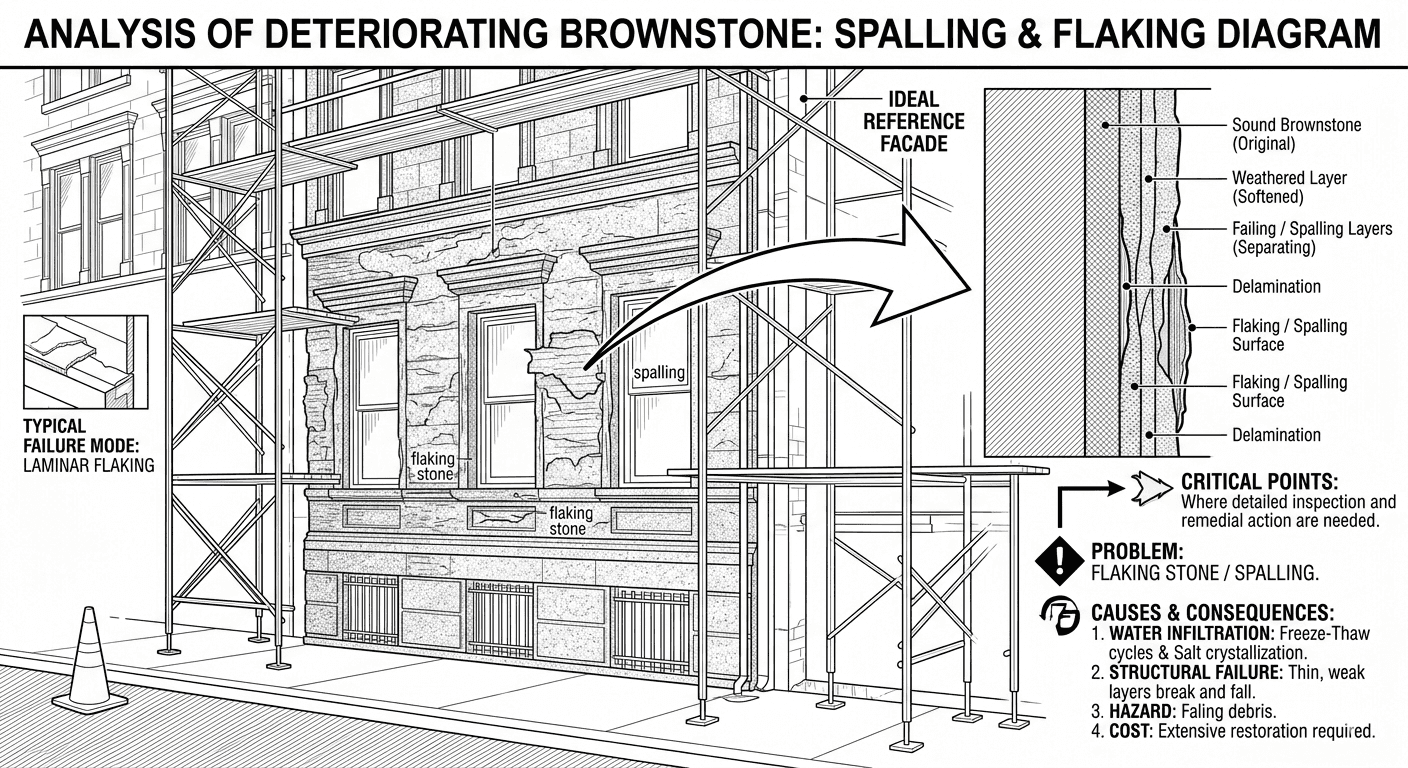
Spalling or flaking stone on the facade surface
Spalling is when the outer layer of your brownstone starts to peel, flake, or pop off in sheets or chunks. You'll often notice small pieces on your stoop, sidewalk, or window sills after a cold winter. This is one of the most common and most misunderstood forms of facade damage. Many homeowners assume it's purely cosmetic. It isn't. Spalling occurs because water has already penetrated the stone, frozen, expanded, and fractured the surface from within. Once the protective outer layer is gone, the softer interior stone is directly exposed to the elements, and deterioration accelerates dramatically. Left unaddressed, spalling spreads across the entire facade and can compromise structural integrity. If you notice flaking or missing stone larger than a quarter, schedule a professional inspection immediately.
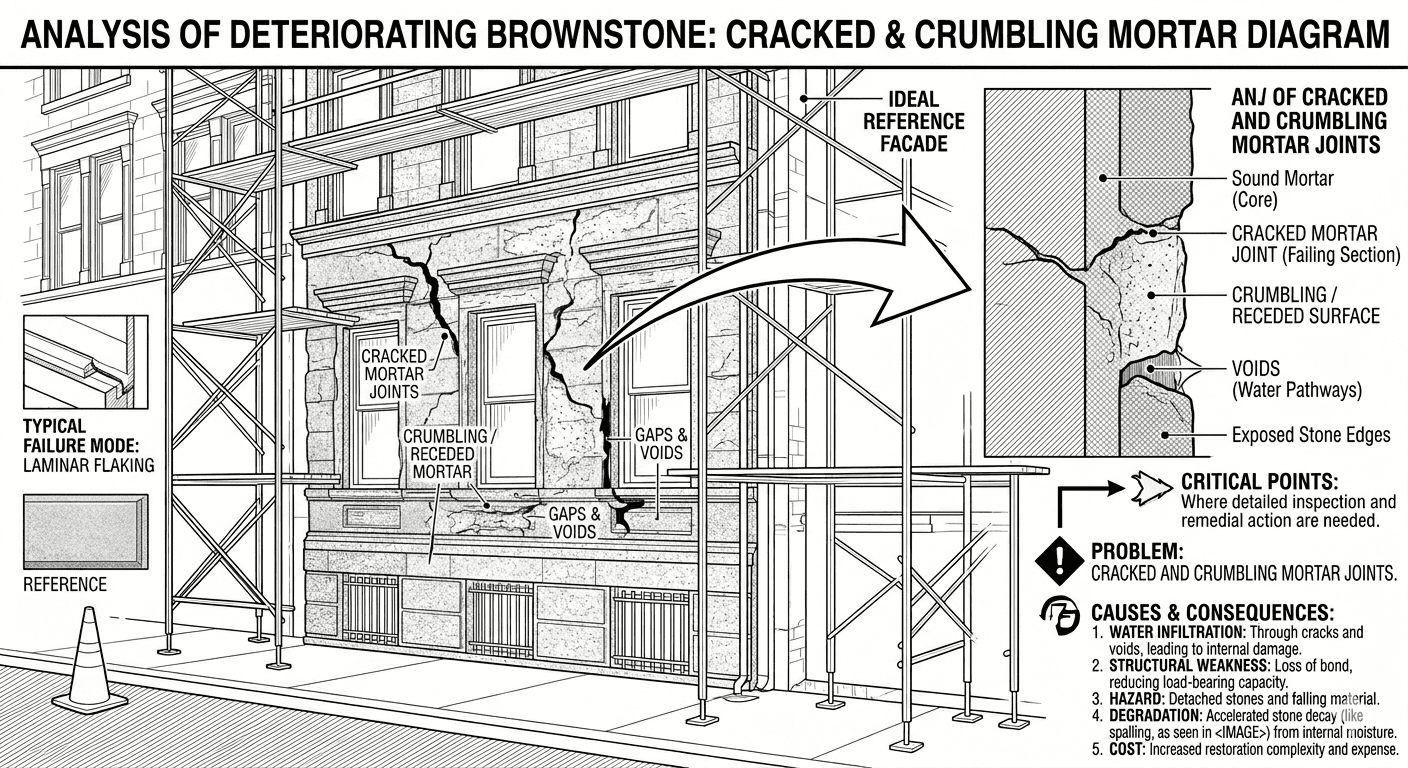
Cracked or crumbling mortar joints between stones
The mortar between your brownstone blocks is actually more vulnerable than the stone itself. Over decades of expansion and contraction from New York's extreme temperature swings from 95°F summers to single-digit winters mortar joints crack, shrink, and eventually crumble away. When you can see gaps, holes, or powdery erosion in the joints between stones, that's called mortar failure, and it's a serious problem. Mortar joints aren't just aesthetic; they're your facade's first line of defense against water infiltration. Once they fail, rainwater channels directly into the wall cavity behind the stone, causing hidden damage to your interior structure that won't show up until it's already extensive. Repointing the process of removing damaged mortar and replacing it with fresh material is one of the most cost-effective investments a brownstone owner can make. Don't wait until you see daylight through the joints.
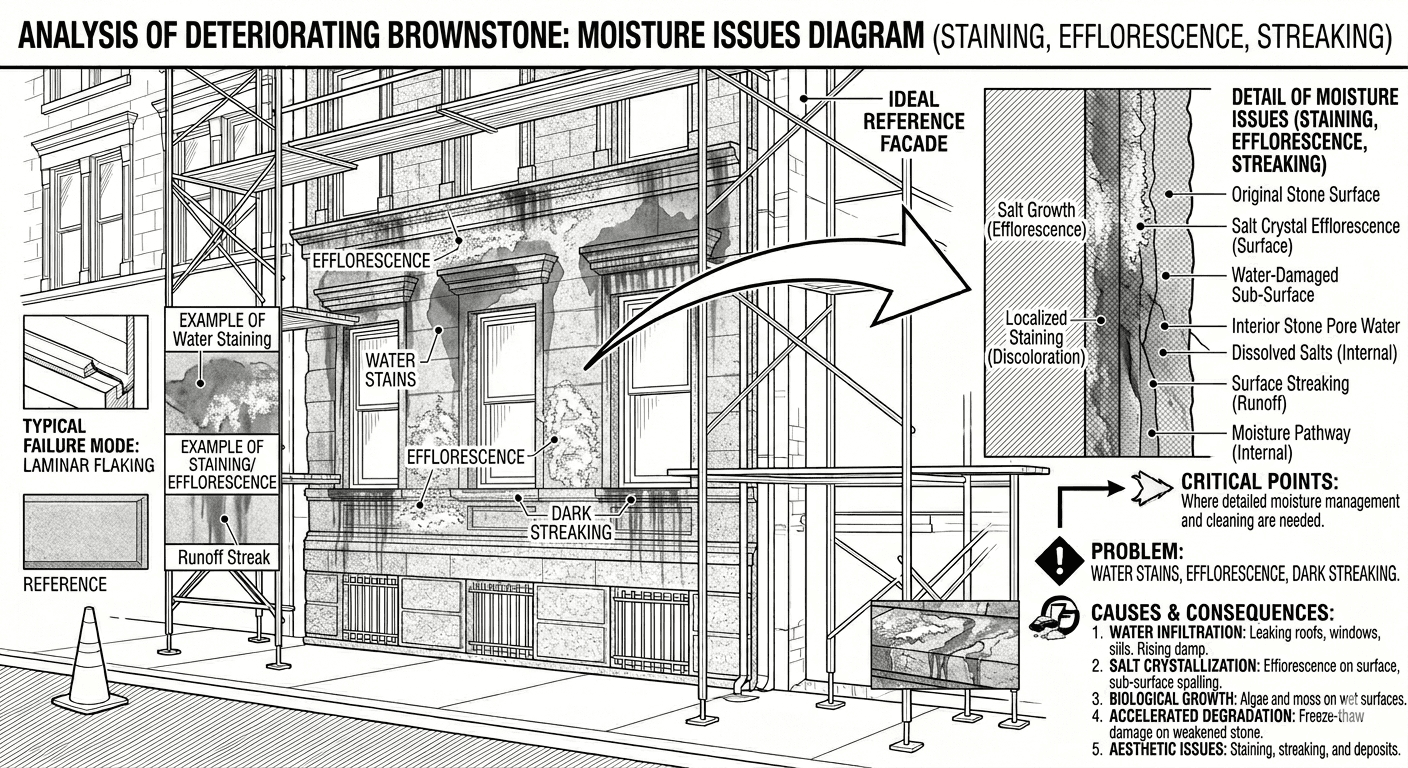
Water stains, dark streaking, or efflorescence on the facade
Look at your facade on a dry day. Do you see vertical dark streaks running down from window sills or cornices? White powdery deposits on the stone surface? These are classic signs of chronic water infiltration. The white powder called efflorescence is mineral salt that's been dissolved by water moving through the masonry and deposited on the surface as the water evaporates. It sounds harmless, but it signals that water is actively moving through your stone, carrying away minerals and weakening the structure internally. Dark streaking usually points to failing waterproofing, damaged flashing, or clogged drainage details that are channeling water across your facade repeatedly. Both issues need to be investigated before the source is sealed otherwise, trapped moisture causes even more damage inside the wall.
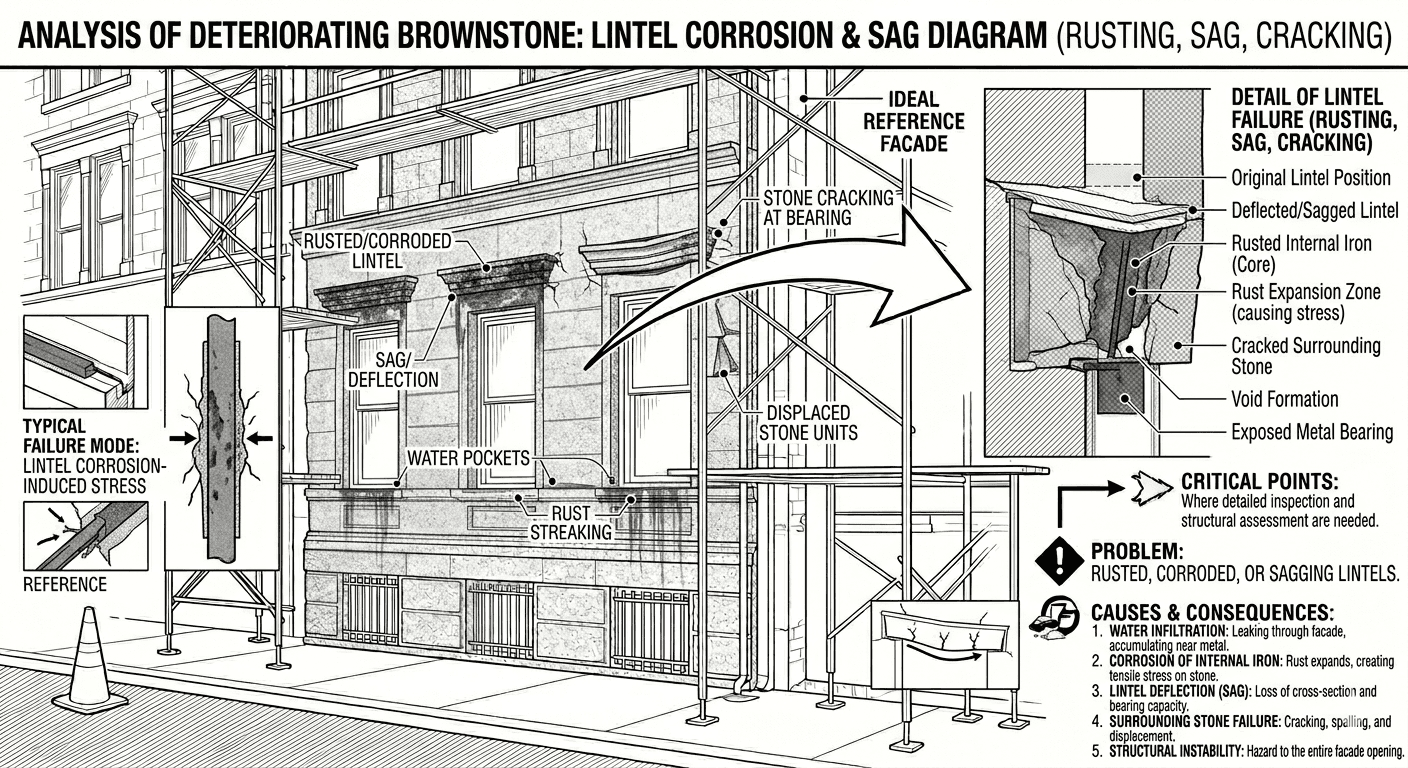
Rusted, corroded, or sagging lintels above windows and doors
Lintels are the horizontal steel or stone beams that span the top of your windows and door openings, carrying the weight of the masonry above. In Brooklyn brownstones built before the 1930s, these are almost always steel and steel rusts. When lintels corrode, they expand, cracking the masonry around them. If you look above your windows and see horizontal cracks radiating outward, rust staining, or sections of stone that appear to be shifting or sagging, that's a failed lintel, and it's a structural safety issue, not just cosmetic damage. In severe cases, failed lintels can cause masonry above windows to detach from the building. This is one problem that absolutely cannot wait. If you notice this on your home, contact a licensed restoration contractor right away and check whether your building requires a DOB filing for the repair.
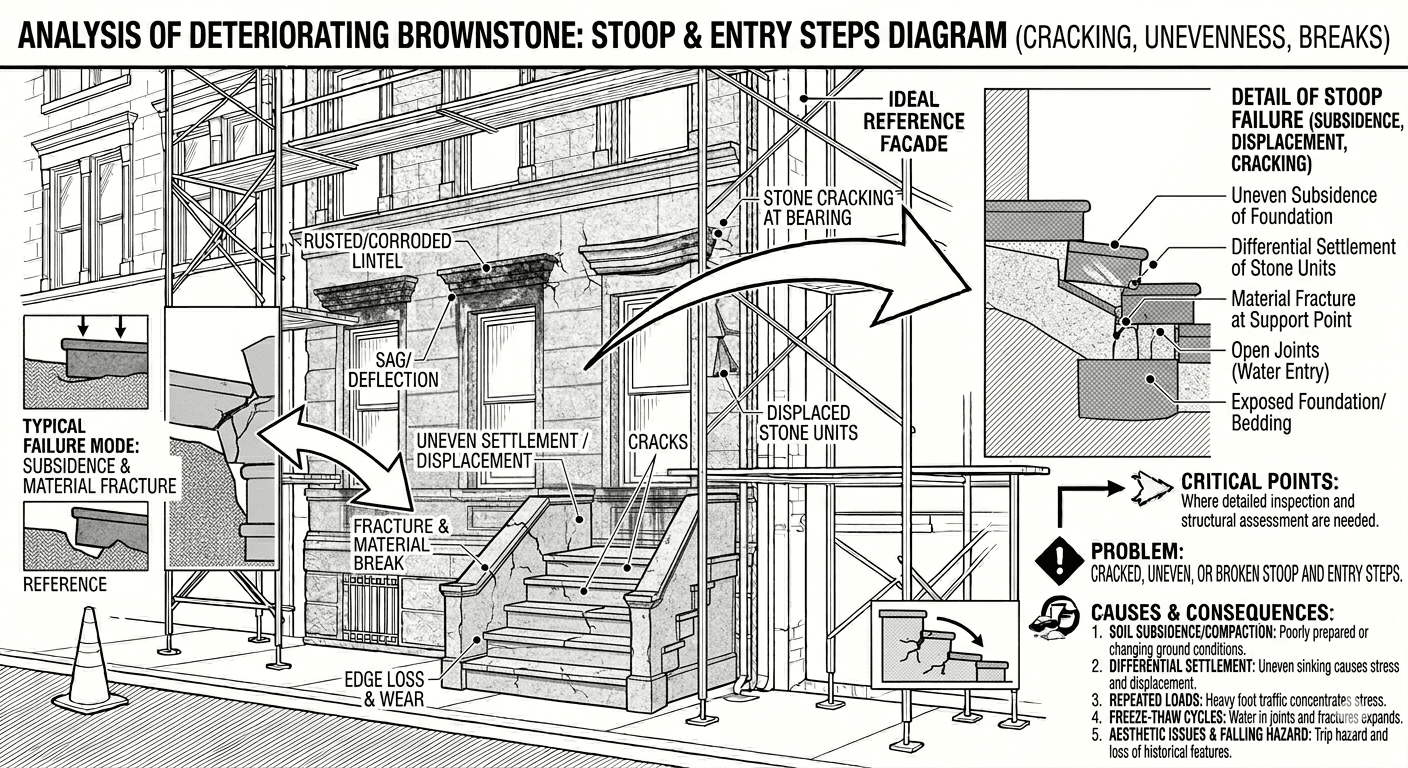
Cracked, uneven, or broken stoop and entry steps
Your stoop takes more abuse than any other part of your brownstone's exterior. Decades of heavy foot traffic, salt application during winter, and constant freeze-thaw stress leave Brooklyn stoops cracked, chipped, and structurally compromised. Beyond the visual impact and a stoop in disrepair significantly hurts your curb appeal and property value cracked steps are a genuine liability risk. Hairline cracks that seem minor often allow water to infiltrate the underlying substrate, which then freezes and expands each winter, accelerating the breakdown. Loose or uneven steps also create trip hazards. Stoop restoration is almost always more economical than full stoop replacement. The key is catching the damage while patch and repair are still viable options once the substrate fails, you're looking at a full rebuild.
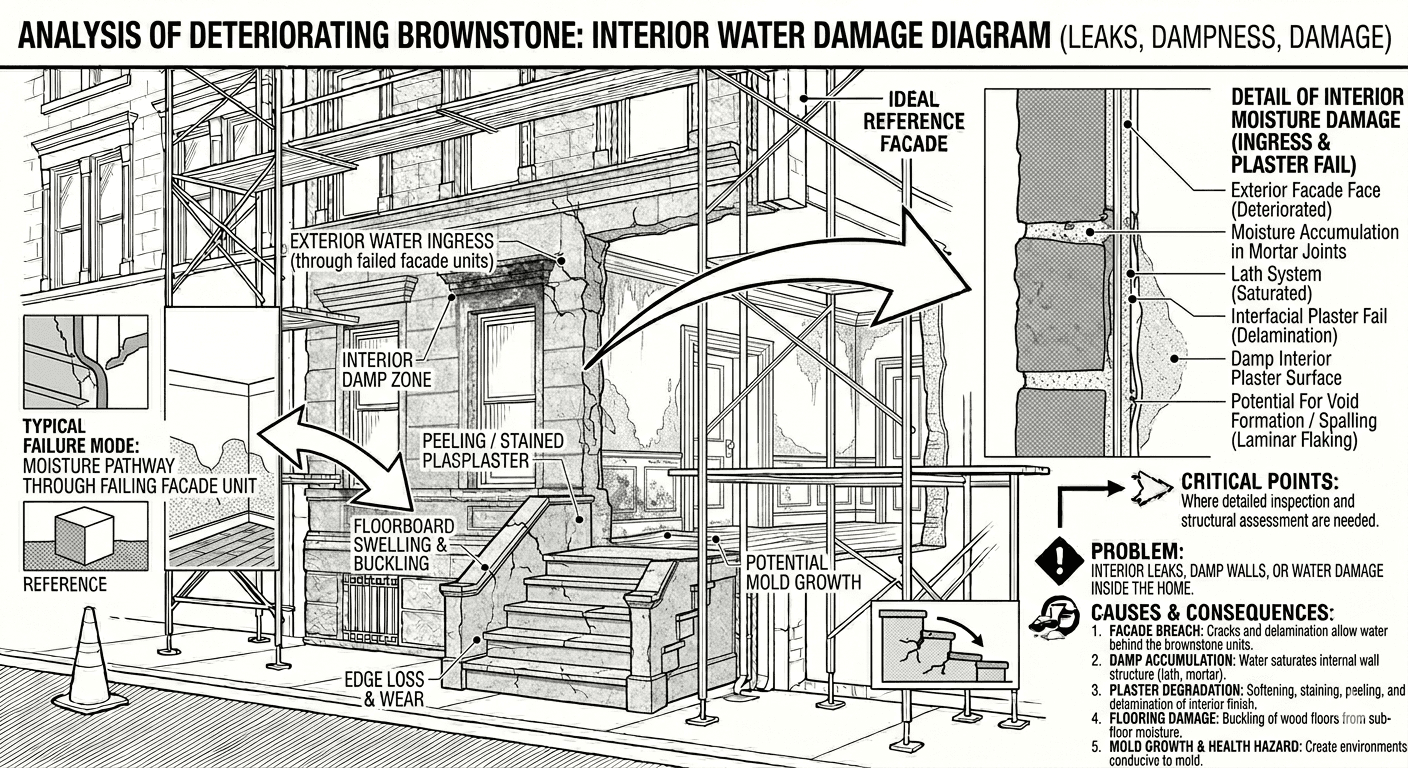
Interior leaks, damp walls, or water damage inside the home
Here's a warning sign many homeowners overlook: if you're seeing water stains on your interior walls, damp spots near windows, peeling paint on interior surfaces, or musty odors in your front rooms, there's a good chance the cause isn't your plumbing it's your facade. Brownstone and brick are porous materials. When waterproofing fails or mortar joints deteriorate, rainwater works its way inward through the wall assembly and shows up on interior finishes. By the time you see interior damage, the water has already traveled through several inches of masonry, soaking insulation and framing along the way. Interior water damage from facade failure is always more extensive than it first appears, and it creates conditions for mold and wood rot that compound the repair costs quickly. An interior damp spot near an exterior wall is your signal to get the outside of your home inspected before anything else.
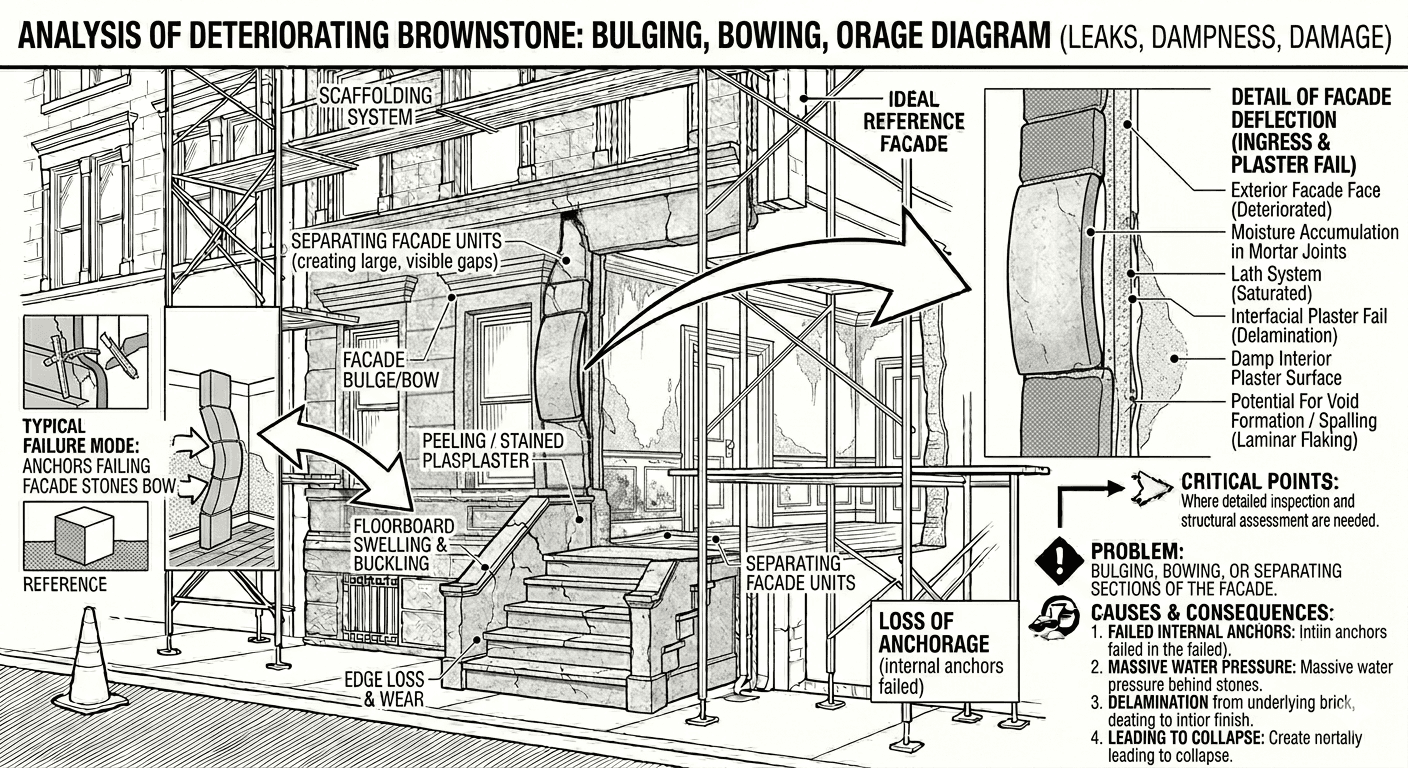
Bulging, bowing, or separating sections of the facade
Stand back from your home and look at the facade as a whole. Is the surface perfectly flat, or do you notice sections that appear to bow outward, bulge slightly, or look slightly separated from the main wall plane? This is one of the least common but most serious warning signs. Bulging or bowing masonry typically indicates that the stone veneer has lost its bond to the backup structure behind it meaning sections of your facade may be at risk of detaching entirely. This can happen when failed mortar, water infiltration, and freeze-thaw damage progressively degrade the connection between the stone face and the structural wall. In New York City, facade failures that drop material to the street are treated as emergency situations by the DOB. If you notice any bowing or bulging, even subtle, do not wait for your next scheduled inspection. Call a licensed contractor today.
How quickly can facade damage get worse?
Faster than most homeowners expect. Brooklyn's climate is particularly punishing on masonry. A hairline crack in November can become a two-inch gap by March, thanks to the cycle of water infiltrating the crack, freezing, expanding, and pushing the crack wider sometimes dozens of times in a single winter. What might cost $800–1,500 to repair in October can easily become a $5,000–15,000 project by spring if left through the freeze-thaw season.
The most expensive brownstone facade repairs we handle are almost always jobs that were spotted early but delayed. Time is the most costly variable in brownstone restoration.
Does your home fall under LPC jurisdiction?
If your brownstone is in a historic district — and much of Park Slope, Brooklyn Heights, Fort Greene, Clinton Hill, and Boerum Hill is — any exterior repair work visible from the street requires prior approval from the NYC Landmarks Preservation Commission (LPC). This includes facade work, stoop repairs, and waterproofing treatments. A qualified brownstone restoration contractor will handle LPC filings and ensure all materials meet the commission's requirements for historical accuracy. Working without proper LPC approval in a designated district can result in stop-work orders, fines, and costly removal of unapproved work.
Noticed any of these warning signs on your home?
Don't wait through another winter. Our Brooklyn-based team offers free on-site facade inspections no obligation, no pressure. We'll tell you exactly what we see and what it means for your home.
Licensed & insured · LPC-compliant · Serving all Brooklyn neighborhoods
Brooklyn's brownstones are some of the most beautiful and most demanding homes in New York City. Built mostly between 1860 and 1910, these historic sandstone facades were designed to last a lifetime. But after more than a century of freeze-thaw cycles, acid rain, urban pollution, and salt air, even the sturdiest facade starts to show its age. The trouble is, most homeowners don't notice the damage until it's already serious.
The good news: brownstone deterioration almost never happens overnight. There are clear warning signs that appear months sometimes years before a small crack becomes a structural emergency. Knowing what to look for can mean the difference between a few thousand dollars in targeted repairs and a full-facade restoration project costing tens of thousands.
We've inspected hundreds of brownstones across Park Slope, Bedford-Stuyvesant, Clinton Hill, Fort Greene, and Brooklyn Heights. These are the seven warning signs we see most often and what each one means for your home.
"Brownstone is a naturally porous, soft sandstone. It absorbs water beautifully and that's exactly the problem. Once water gets in and freezes, it expands, and the damage accelerates fast."
Spalling or flaking stone on the facade surface
Spalling is when the outer layer of your brownstone starts to peel, flake, or pop off in sheets or chunks. You'll often notice small pieces on your stoop, sidewalk, or window sills after a cold winter. This is one of the most common and most misunderstood forms of facade damage. Many homeowners assume it's purely cosmetic. It isn't. Spalling occurs because water has already penetrated the stone, frozen, expanded, and fractured the surface from within. Once the protective outer layer is gone, the softer interior stone is directly exposed to the elements, and deterioration accelerates dramatically. Left unaddressed, spalling spreads across the entire facade and can compromise structural integrity. If you notice flaking or missing stone larger than a quarter, schedule a professional inspection immediately.
Cracked or crumbling mortar joints between stones
The mortar between your brownstone blocks is actually more vulnerable than the stone itself. Over decades of expansion and contraction from New York's extreme temperature swings from 95°F summers to single-digit winters mortar joints crack, shrink, and eventually crumble away. When you can see gaps, holes, or powdery erosion in the joints between stones, that's called mortar failure, and it's a serious problem. Mortar joints aren't just aesthetic; they're your facade's first line of defense against water infiltration. Once they fail, rainwater channels directly into the wall cavity behind the stone, causing hidden damage to your interior structure that won't show up until it's already extensive. Repointing the process of removing damaged mortar and replacing it with fresh material is one of the most cost-effective investments a brownstone owner can make. Don't wait until you see daylight through the joints.
Water stains, dark streaking, or efflorescence on the facade
Look at your facade on a dry day. Do you see vertical dark streaks running down from window sills or cornices? White powdery deposits on the stone surface? These are classic signs of chronic water infiltration. The white powder called efflorescence is mineral salt that's been dissolved by water moving through the masonry and deposited on the surface as the water evaporates. It sounds harmless, but it signals that water is actively moving through your stone, carrying away minerals and weakening the structure internally. Dark streaking usually points to failing waterproofing, damaged flashing, or clogged drainage details that are channeling water across your facade repeatedly. Both issues need to be investigated before the source is sealed otherwise, trapped moisture causes even more damage inside the wall.
Rusted, corroded, or sagging lintels above windows and doors
Lintels are the horizontal steel or stone beams that span the top of your windows and door openings, carrying the weight of the masonry above. In Brooklyn brownstones built before the 1930s, these are almost always steel and steel rusts. When lintels corrode, they expand, cracking the masonry around them. If you look above your windows and see horizontal cracks radiating outward, rust staining, or sections of stone that appear to be shifting or sagging, that's a failed lintel, and it's a structural safety issue, not just cosmetic damage. In severe cases, failed lintels can cause masonry above windows to detach from the building. This is one problem that absolutely cannot wait. If you notice this on your home, contact a licensed restoration contractor right away and check whether your building requires a DOB filing for the repair.
Cracked, uneven, or broken stoop and entry steps
Your stoop takes more abuse than any other part of your brownstone's exterior. Decades of heavy foot traffic, salt application during winter, and constant freeze-thaw stress leave Brooklyn stoops cracked, chipped, and structurally compromised. Beyond the visual impact and a stoop in disrepair significantly hurts your curb appeal and property value cracked steps are a genuine liability risk. Hairline cracks that seem minor often allow water to infiltrate the underlying substrate, which then freezes and expands each winter, accelerating the breakdown. Loose or uneven steps also create trip hazards. Stoop restoration is almost always more economical than full stoop replacement. The key is catching the damage while patch and repair are still viable options once the substrate fails, you're looking at a full rebuild.
Interior leaks, damp walls, or water damage inside the home
Here's a warning sign many homeowners overlook: if you're seeing water stains on your interior walls, damp spots near windows, peeling paint on interior surfaces, or musty odors in your front rooms, there's a good chance the cause isn't your plumbing it's your facade. Brownstone and brick are porous materials. When waterproofing fails or mortar joints deteriorate, rainwater works its way inward through the wall assembly and shows up on interior finishes. By the time you see interior damage, the water has already traveled through several inches of masonry, soaking insulation and framing along the way. Interior water damage from facade failure is always more extensive than it first appears, and it creates conditions for mold and wood rot that compound the repair costs quickly. An interior damp spot near an exterior wall is your signal to get the outside of your home inspected before anything else.
Bulging, bowing, or separating sections of the facade
Stand back from your home and look at the facade as a whole. Is the surface perfectly flat, or do you notice sections that appear to bow outward, bulge slightly, or look slightly separated from the main wall plane? This is one of the least common but most serious warning signs. Bulging or bowing masonry typically indicates that the stone veneer has lost its bond to the backup structure behind it meaning sections of your facade may be at risk of detaching entirely. This can happen when failed mortar, water infiltration, and freeze-thaw damage progressively degrade the connection between the stone face and the structural wall. In New York City, facade failures that drop material to the street are treated as emergency situations by the DOB. If you notice any bowing or bulging, even subtle, do not wait for your next scheduled inspection. Call a licensed contractor today.
How quickly can facade damage get worse?
Faster than most homeowners expect. Brooklyn's climate is particularly punishing on masonry. A hairline crack in November can become a two-inch gap by March, thanks to the cycle of water infiltrating the crack, freezing, expanding, and pushing the crack wider sometimes dozens of times in a single winter. What might cost $800–1,500 to repair in October can easily become a $5,000–15,000 project by spring if left through the freeze-thaw season.
The most expensive brownstone facade repairs we handle are almost always jobs that were spotted early but delayed. Time is the most costly variable in brownstone restoration.
Does your home fall under LPC jurisdiction?
If your brownstone is in a historic district — and much of Park Slope, Brooklyn Heights, Fort Greene, Clinton Hill, and Boerum Hill is — any exterior repair work visible from the street requires prior approval from the NYC Landmarks Preservation Commission (LPC). This includes facade work, stoop repairs, and waterproofing treatments. A qualified brownstone restoration contractor will handle LPC filings and ensure all materials meet the commission's requirements for historical accuracy. Working without proper LPC approval in a designated district can result in stop-work orders, fines, and costly removal of unapproved work.
Noticed any of these warning signs on your home?
Don't wait through another winter. Our Brooklyn-based team offers free on-site facade inspections no obligation, no pressure. We'll tell you exactly what we see and what it means for your home.
Licensed & insured · LPC-compliant · Serving all Brooklyn neighborhoods
Licensed & insured · LPC-compliant products · Serving all Brooklyn neighborhoods
Licensed & insured · LPC-compliant products · Serving all Brooklyn neighborhoods
Frequently Asked Questions
Your questions, Our answers
How often does brownstone waterproofing need to be reapplied?
Do I need Landmarks Preservation Commission (LPC) approval for my Brooklyn brownstone restoration?
How much does professional brownstone waterproofing cost in Brooklyn?
Do I need Landmarks Preservation Commission (LPC) approval for my Brooklyn brownstone restoration?
Does the brownstone stoop need to be waterproofed separately?
Do I need Landmarks Preservation Commission (LPC) approval for my Brooklyn brownstone restoration?
Can waterproofing be applied to a facade that's already damaged?
Do I need Landmarks Preservation Commission (LPC) approval for my Brooklyn brownstone restoration?
NYC HIC License Number: 2049861-DCA
Address:📍3623 15th Ave, Brooklyn, NY 11218, United States
Call us at: +1347-328-7203
Quick Links
Areas Served
Park Slope
Brooklyn Heights
Carroll Gardens
Upper West Side
Chelsea
Tribeca
NYC HIC License Number: 2049861-DCA
Address:📍3623 15th Ave, Brooklyn, NY 11218, United States
Phone: +1347-328-7203
Quick Links
Areas Served
Park Slope
Brooklyn Heights
Carrol Gardens
Upper West Side
Chelsea
Tribeca
NYC HIC License Number: 2049861-DCA
Call us at: +1347-328-7203
Address:📍3623 15th Ave, Brooklyn, NY 11218, United States
Quick Links